

The personal operating system. And why you need it.


The perfect productivity trap
If you are like me, you have spent a lot of time creating the perfect setup for being productive and getting work done efficiently. But despite all your effort, you still feel busy, work gets cluttered and your aren’t able to get things done as you want to. Your setup doesn’t hold, the tool isn’t working the way you wanted.
Building a complex setup in Notion and starting your Monday with optimism saying «this week I will be productive» isn't doing it. When your system fail, you go back to spending more time on the tool, and beating yourself up for not being able to follow the system you created.
This behavior is normal, and most people start to feel bad about themselves when they end up in this productivity trap, spending more time on tools than actually getting things done. Contrary to what many people think, we don't see this as a discipline problem, it is a design problem.
Enter your own personalOS
It’s time to look at all of this from another perspective. You don’t need another productivity stack, a new morning routine or a set of habits. You need to rethink the whole approach to how you do this, and the better solution is to create your own personalOS.
A personalOS is the complete system by which you make decisions, manage attention, and do your best work — consciously designed rather than accumulated by accident or from random sources online.
Our belief is that a personalOS is exactly that, personal. And that personalOS needs to go deeper than the tools and easy fixes you find online. It requires real effort, conscious reflection and it should be a constant process of doing and improving. There is no one recipe that works for all, you need to create the system that works for you.
The good news is that even though there is no universal recipe, we believe there is a blueprint that we all can build our personalOS upon. We call it The personalOS Model.
Introducing the personalOS Model
The personalOS Model is the blueprint from where you can start building your own personalOS. It consists of three layers; the Surface, the Structure and the Bedrock. And then you have the Feedback Loop, that examines and informs your system, the most important part in order for you to improve.
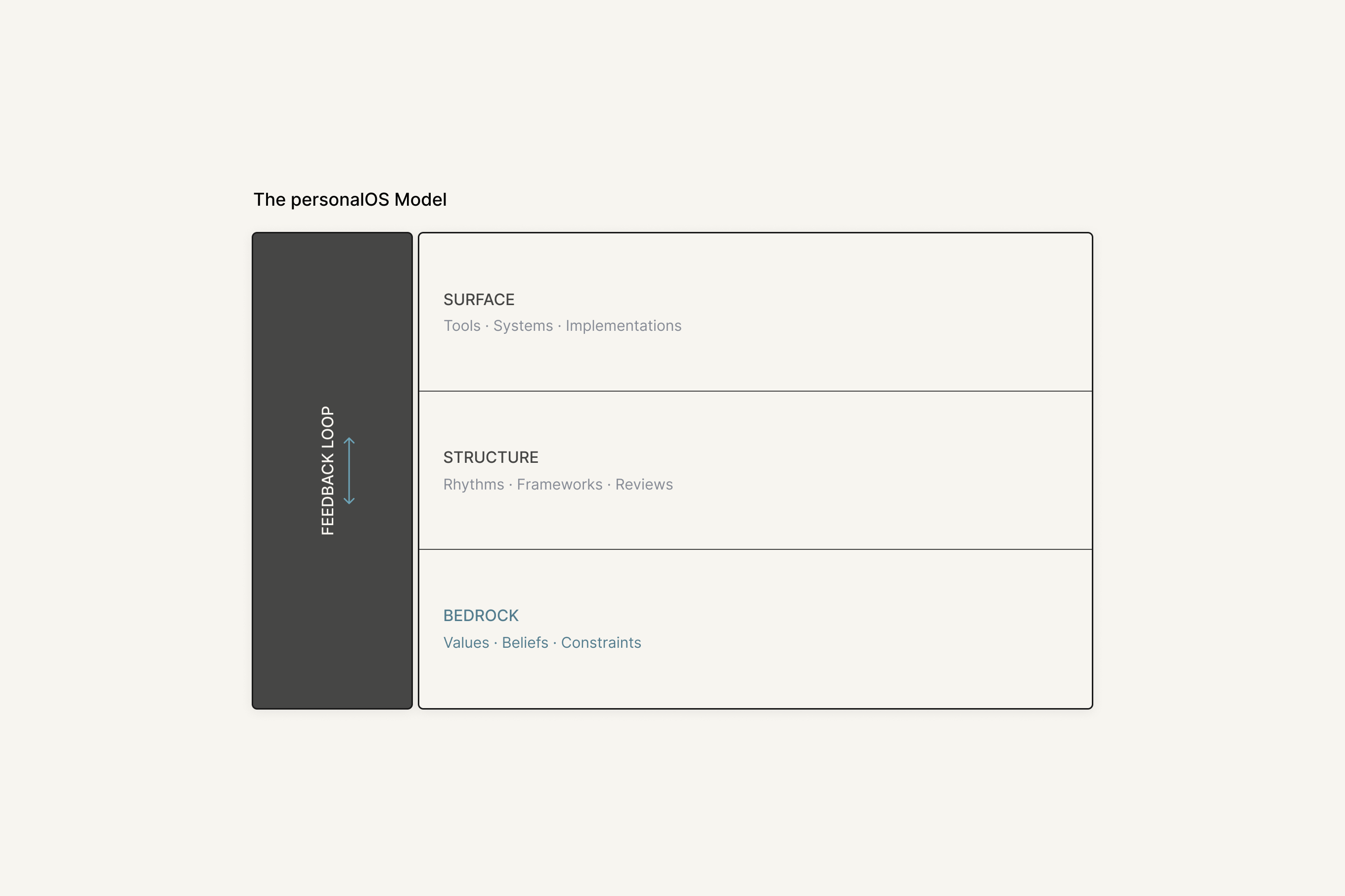
Surface - the visible layer
The Surface is the layer that is visible and tangible. This is where you have all the implementations, tools and apps. In fact, this is where almost all of your productivity content lives. When you browse around for hacks and tool implementations, this is the layer you are working on.
The Surface is crucial for making things happen, but in fact this is the least load-bearing layer. Tools, apps and implementations change, your work and life situations change, so this layer have to be flexible. You should be aware of that, and make sure don't get locked in to the tools and apps.
An example here is the PARA framework. There is a big difference between PARA-in-Notion versus PARA-as-logic. PARA is a really good framework, but the cost of switching the implementation is invisible until you count it. Every time you migrate from Notion to Obsidian to Apple Notes, you pay a tax - re-entering structure, re-learning shortcuts, losing momentum on whatever you were actually doing.
Tools have opinions, and you inherit them silently. Notion wants you to build databases. Obsidian wants you to think in links. Every tool nudges your Structure toward its own defaults, and you need to make sure you are not being shaped by software, you should be the one shaping it to your needs and your behaviors.
Because the Surface is where novelty lives and where your work is visible, this layer can be seductive. New tools and implementation feel like progress because they're stimulating.
This is why you need the Surface to serve your Structure, not the other way around. You build the logic and mental models first, then you choose the tool that serves it.
Structure - the operating layer
The thing that is broken is often a Surface complaint about a Structure problem. "My task manager isn't working" is rarely about the task manager. It's usually that you don't have a real review rhythm, so tasks pile up regardless of which app holds them.
And that is what the Structure layer is all about. This is the operating layer, where your rhythms, frameworks and review cycles lives in a more fundamental way than on the Surface layer. It takes time to develop this layer, and often we fail because we aim to high before establishing the basics.
Almost everyone has tried to establish a weekly review, only to find that you abandoned it before a month has gone by. This is almost never due to laziness, it's because that review was designed for an idealised version of your week, not the actual one. Maybe you need a daily shutdown routine, where you close the loop and transition between work-mode and everything else. This is the simplest example of what the Structure is about, where you reflect on how you want to work, and not just implement a task list or review you read somewhere.
This layer is also where things starts to fail more fundamentally. When you start using other peoples frameworks, you are borrowing Surface implementations from their Bedrock. Time-blocking can work extremely well for some people, but won't work if your Bedrock includes high responsiveness to others, or your work is inherently reactive. GTD encodes David Allen's belief that an open loop is a tax on attention. PARA encodes Tiago Forte's belief that information should be organized by actionability, not topic.
When you adopt a framework, you're adopting someone else's answer to a Bedrock question you may not have asked yourself. So you need to be honest about what is important to you in your life, how you want to live and how you are wired as a person. The Bedrock is the layer to answer those thing.
Bedrock - your values, beliefs and operating constraints
The Bedrock is the layer that guides everything else in life, and paradoxically is the layer that most people never examines. Maybe this is natural, because examining this layer is hard. It requires purpose, real examination, and honesty about what you actually want.
Most of us will feel it deeply when there is dissonance between you Bedrock and the other layers. Either because you brute force your work and life, and do things in contradiction with your values and beliefs. Or you simply aren't able to follow the Surface and Structure you created, because you don't want to work and live the way a framework is designed on someone else's Bedrock. This is why skipping this layer is the root cause of most system failures.
There is an abundance of interviews, information and promotion of successful people, where you see how they are super productive and spend their whole life building cool products. Or a founder who sleeps four hours and calls it a competitive advantage. But most of us aren't like that. We want to have some sort of balance in life, spend time with the family, see our friends and create experiences outside the office. You need to be honest about what is important to you, and make sure everything else builds upon those beliefs.
This is why Bedrock also includes explicitly stating what your not willing to do, not just what you value. Most personal values are aspirational - "I value deep work". But a sharper and more honest version also names your constraints. "I am not willing so sacrifice dinner with the family for anyone", "I'm not willing to optimise my mornings for output at the cost of how I feel in them". Constraints are more actionable than values because they're falsifiable — you either honored them this week or you didn't.
In our Bedrock at The Working Theory we are firm in our belief that there are no hacks that will work in the long-term. This is why we are patient, and anti-hustle. We are not in the business of 5am routines or productivity theatre. We believe in the compounding of small wins over time, which requires patience. So, we are curious, not prescriptive. Our content are working theories, not commandments, and they are subject to revision. We will tell you about what works, and also what doesn't work.
Bedrock is expensive to examine and expensive to ignore — just on different timelines. Examining it costs you discomfort now. Ignoring it costs you a system that quietly fights itself for years. This leads us to the last piece of the personalOS Model, The Feedback Loop.
The feedback Loop - where it all comes together
This is the practice that runs through the other three layers. Without the Feedback Loop, the model is just taxonomy. Bedrock, Structure, and Surface describe what a personalOS is made of. The Feedback Loop is the only layer that explains how it stays alive, and without it the other layers will slowly drift out of date with who you've become.
Almost everyone has experienced a system that ran well for six months and then quietly stopped. The instinct is to blame the tool or the framework. But the more honest diagnosis is usually that something changed at a deeper layer — a new job, a new responsibility, a shift in what matters — and the system kept running on old assumptions. That moment of "this isn't working anymore" is the Feedback Loop asking to be activated. The feeling of friction is data, not failure.
The most common Feedback Loop failure isn't absence of reflection — it's reflection at the wrong layer. You feel friction in your system and spends three hours redesigning your Notion workspace. The friction was real, but the response was aimed at the wrong level. Surface tinkering in response to a Structure problem. Structure tweaking in response to a Bedrock problem. It is worth asking yourself if this is this a tool problem, a rhythm problem, or a deeper belief problem? That question alone is most of what the Feedback Loop is for.
In your practice you will probably do an operational review frequently. This could be a 20-30 minutes weekly review, where you examine if you did as intended, close the week and open the next one. This lives in Structure.
On a deeper level you will do a systems review, and this type of review lives in the Feedback Loop. Here you will look back, elevate your field of vision, and examine if the system itself is still serving you. Are your rhythms right for your current life? Are the frameworks producing the outcomes you want? You will do this less frequent, maybe monthly or quarterly, and it will probably take longer, feel less comfortable and require much deeper reflection than an operational review.
You should also do a Bedrock review, although this is harder to schedule and won't have a fixed cadence. This review is on the value level, and will usually be forced by bigger changes in your life. Am I building towards the right thing in life? The answer to this will probably change from when you are 23 years old and without commitments, to when you are 45 years old, have a partner and a family.
The Feedback Loop is what The Working Theory is actually for. Not to give you the right tools or the right frameworks, but to give you better questions to ask about the system you're already running. Every Foundation piece, every experiment, every tool review is an input to your Feedback Loop, not a prescription. You decide what to do with it.
What does this mean for you as a reader
At The Working Theory we will explore all three layers in the model across all our content, and we will be clear on what is evergreen and proven content, and when we are in a landscape of experimentation and testing.
Some pieces will go deep on frameworks and mental models that underpin good personal systems. Like the article you are reading now, these will be tool-agnostic and load-bearing articles. They will be written once, and referenced often in the more experimental pieces, and they are built to hold up over time. We will also do tool deep-dives, and document experiments with a hypothesis and an honest result, and give you shorter observations from the work in progress.
Whether the article is a long-form evergreen or a tool deep-dive, we will make sure to anchor the article in the personalOS Model. We will be clear on which layer we are operating in, and we will try to bridge the layers and give you data on what prerequisites is needed for the described piece to work.
What you will not find is the one ring to rule them all. We fundamentally don't believe in hacks and hustle culture. That doesn't mean that you won't find light weight tools or frameworks, but we won't try to sell you "the one thing that solves everything". As described in the Bedrock, we believe that small improvements will compound over time, and that requires time and patience.
A new beginning
Like we started with, most of us have tried for a long time to find a system that works, only to realize that there really isn't one thing that solves it all. It takes time, patience, conscious reflection and a constant process of doing and improving. We believe that most failures to produce durable systems aren't due to lack of discipline, it is a design problem.
Durable systems are built from the bottom up, examined from the top down, and improved continuously through the Feedback Loop. Helping you find the design that works for you is the purpose of The Working Theory. We will use the personalOS Model to examine all layers and a variety of tools, systems, frameworks, and mental model. The blueprint is universal, but it is up to you to stay curious and fill it with the building blocks that works in your life.
Subscribe to my newsletter to get the latest updates and news